
WHY I WRITE:
How Literature Chose Me

…….for Gail Caldwell
When I was 17 years old and a gloomy freshman at Duke University, I heard the novelist Reynolds Price reading aloud from a brief play by J. M. Synge called “Riders to the Sea” and literature seized me by the throat, lifting me into what seemed like mid-air. I had never felt the way I did listening to these passages, and I kept glancing around the room, wondering if others were being carried away into this ether. Hearing “Riders to the Sea” changed my brain.
There are metaphors for what happened to me, of course, as well as other descriptions: I was glimpsing what T.S. Eliot called “the still point of the turning world”, the place where art moves perpetually, like “a Chinese vase turning in the stillness.” Instantly I was transformed into a literary junkie, desperate for anything that could re-create this experience. The idea that I might someday become the medium through which such a text could be born was not yet conceivable.
I’d been miserable as a teenager. My father was killed in an accident when I was 12 and my family, stuck on a creepy old plantation outside of Charleston, South Carolina, disintegrated. The civil rights movement was exploding around us, and, overwhelmed by grief, fear, and confusion, I slogged on, driving the younger kids to school (I got my license at 14), while a growing recognition of my ignorance kept slapping me in the face. I was attending a poor country high school where I never wrote a paper, and the English teacher would say, “Listen at me, y’all.” I skipped the 11th grade and didn’t bother taking my books home senior year. I only applied to Duke because I didn’t understand that you could apply to more than one school, and I suspect I only got admitted because of my scores on national tests. Even as a teenager I knew that national tests would be the key to escaping South Carolina. Alcohol had already become a problem, and I was drunk at every opportunity.
Reynolds Price, the famous young writer now teaching at Duke, had rejected me from his writing class. Price was from North Carolina, but he had been to Oxford and now spoke with a British accent, which I thought was a ridiculous affectation. But I had never heard anything as beautiful, as exquisitely moving, as the passages he read from “Riders to the Sea”, nor had I felt such an overwhelming, bewildering release. It came from a source inside me I hadn’t even known existed.
And Price had rejected me from his writing class! So okay, the scene I had written for the competition was about a young woman who threw a water ski through her dying sister’s hospital window, and, yes, that wasn’t very good, but I could feel the genuine love and grief behind the water ski, even if I couldn’t create it for a reader. And anyway, why was a water ski in a hospital room?
J. M. Synge wrote “Riders to the Sea” over a hundred years ago, and Katherine Anne Porter wrote “The Jilting of Granny Weatherall” almost that long ago also, and they are among the writers I measure my literary efforts against. Theirs is the only game I’ve ever aspired to join. I’d rather have written Katherine Anne Porter’s novella “Pale Horse, Pale Rider” than everything Doris Lessing – who won the Nobel Prize - produced. Sometimes I do wish I’d fallen in love with writers who produced longer narratives because I’ve never written many pages. Only six books, and, of those, only four that I believe are actually good. My first two novels are talented, but they are not good. I used to tell my students that the hardest inch you will ever cross is the difference between being talented and being good.
When I was18 I quit Duke, where I’d been doing poorly, and married a man who wouldn’t let me drink, and finally admitted to him, in hopelessness, that I would have liked to be a writer but knew I was too ignorant, didn’t have the vocabulary, and didn’t know shit about literature. I hadn’t come from a background where such things were valued. Maybe those are advantages, he said, because no one has ever told you what to think. Dean Boyd was a smart, kind man. We agreed that I would go back to school and major in English literature.
My first semester at Pomona College, I wrote a short story that picked me up and carried me. I couldn’t stop writing it, and for several nights Dean came home from his long commute to pop frozen meals into an oven. I had no idea where this story was coming from, but I knew it was good, and it placed in every national contest that I entered. It also won me a prestigious Wallace Stegner Fellowship in Creative Writing at Stanford University.
I arrived at Stanford in 1967 still dressed like a Duke undergraduate, and another writing Fellow, assuming I worked for the program, asked me to get him a glass of wine. I went home and butched my hair, and for the first meeting of the Fellows, I dressed all in black and smoked a cigar at the conference table. I couldn’t even keep it lit, but the same guy didn’t recognize me and asked me out for a beer. At the Stanford Writing Center I was the youngest Fellow, the only woman, and the only one not yet published.
Seventeen years later, when the Duke University library asked to start collecting my papers, I felt vindicated. By then I had published two novels that unfortunately did not meet my literary standards, but I had written a collection of narrative nonfiction that did. I wrote the 13 pieces that comprise The Redneck Way of Knowledge for the Village Voice, a weekly newspaper in NYC, and 6 of them ran on the cover. Who knew Yankees would be so interested in South Carolina? (Why did you call us rednecks, my mother once asked. Well, I said, we’re not aristocrats and we’re not trash, so what’s left?)
These pieces began to attract some serious literary attention. When one of the best editors in New York invited me into her office and described the first Voice piece, “Aunt Thelma at the Rockettes”, as ‘a little classic,’ I tried not to look stunned. When the second essay, the title piece, came out, she bought a book I hadn’t yet written. As I created the other pieces, a woman I knew slightly stopped me on the street: I can’t believe a woman has figured out how to write like this! And once I saw a young woman on the subway reading my first novel, Nerves, and I wanted to snatch it right out of her hands shouting Not good enough! Not good enough! But maybe, maybe, maybe I had become a writer.
I wasn’t sure what the Duke library folks meant by ‘my papers.’ A librarian there explained it to me, so now I knew what to do with all those boxes of drafts and unfinished work that had been accumulating around me. I just shipped them off to Duke and didn’t even have to pay the postage!
Then I got even luckier. Connecticut College hired me as their Writer-in-Residence. This would only be a one semester appointment, and it wouldn’t start for another 15 months, which gave me enough time to join Alcoholics Anonymous and undergo an astounding transformation. I just don’t understand what has happened to you, a good friend said when I was a year sober, you’re exactly the same and completely different. l like to joke that when I quit drinking, I went from being dangerous to picturesque.
Teaching creative writing came instinctively to me, and I was astounded to be paid so well to do something that seemed both easy and satisfying. Students had to apply for admission to my classes, and I paid deep attention to those I admitted. I believed in their abilities more than they did, and I tried to teach them what I wished I had been taught. Talent is cheap. Good writing is very, very hard. You’ve only got 26 letters and a space bar, and it’s just a bunch of squiggles. You must demand your readers’ attention by how good you are.
40 years later I retired with tenure, which I hadn’t particularly wanted, and a job title that took two lines to type. By then a slew of former students had eclipsed me in the literary world, among them David Grann, Sloane Crosley, Hannah Tinti, Russell Rowland, Ann Napolitano, Jazmine Hughes, and Lee Eisenberg, who produced the tv series The Office. There are lots of others I could list here, so don’t be offended if I’ve left you off. I’m almost 80 now and just trying to wind things down.
The Accidental Trilogy: Blacklock
At Stanford I had been too insecure to confess my real literary ambition, because what I secretly wanted was to write was a trilogy, or even a tetralogy. This seemed a ridiculous aspiration since I could hardly complete anything. I did not know yet how to relocate that vein that had yielded my first good story, and I was beginning to realize that all narrative is middle, except for births and deaths, so story structure has to be imposed. For a long time, no matter what I tried to write, fragments kept falling out of my frames, and my stories ended in mid-air. I admired and envied Ford Madox Ford’s tetralogy, Parade’s End, and Lawrence Durrell’s Alexandrian Quartet partly because, if I could write the way they had, I would not have to get everything into one book.
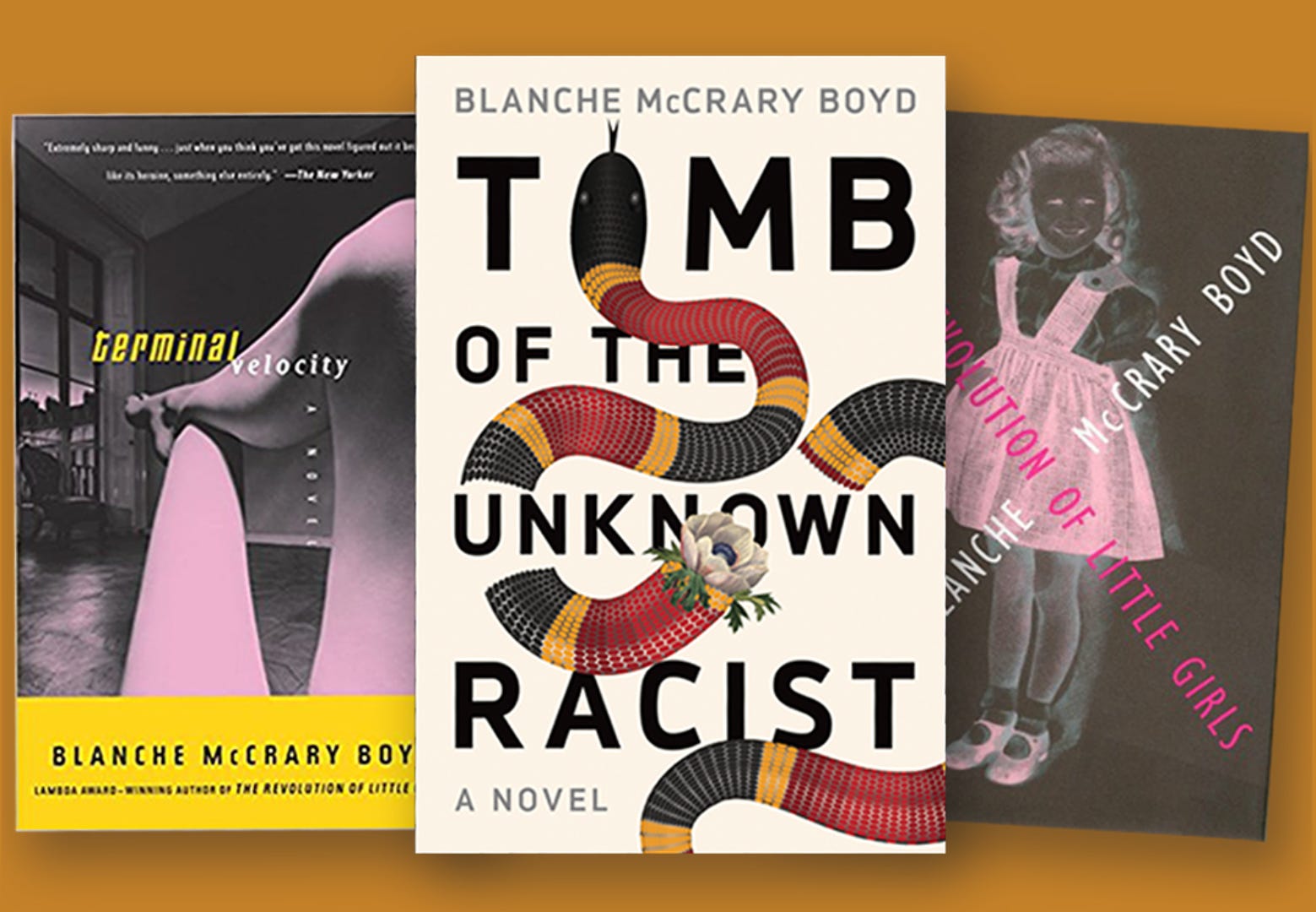
It took me 30 years to finish what I now think of as The Blacklock Trilogy, three novels that are all narrated by the same woman, Ellen Burns. Blacklock is the name of the rickety plantation where she lived as a teenager, and important scenes embodying racial conflict take place there. The Revolution of Little Girls came out in 1988, Terminal Velocity in 1997, and Tomb of the Unknown Racist in 2018, completing an interwoven narrative that I hope embodies the major themes of the second half of the 20th century in America: gender, race, class, and the patriotisms of both left and right. At the conclusion of Tomb of the Unknown Racist, I killed Ellen Burns off with a literary trick pool shot: she narrates her own death. This work, my major literary goal, was now complete.
The Revolution of Little Girls had won the Lambda Award for Lesbian Fiction in 1989, although it contained no actual lesbian scenes. Reportedly, this had created a bit of controversy among the judges. Once, at a reading, a woman raised her hand to ask, “When does Ellen come out?” Being from South Carolina, I got confused and said, “As a debutante?” Then I understood. “Oh, you mean as a lesbian. No, this is not a coming out book, this is a came out book. Ellen is already a lesbian.”
But I did understand that, as gay women, we were all starving for literary scenes of sexual intimacy that would feel authentic, scenes that could reflect the intensities and mysteries of sexual love kindled between women. Even I wanted to understand it. How could this transformation, this step through the mirror, have happened to me? So I wrote Terminal Velocity, Ellen Burns’ coming-out story, which was nominated for the Lambda Award in 1997, but, ironically, didn’t win.
Then I met the woman who would become my wife, and on Leap Year Day of the year 2000, she gave birth to our twins. Leslie was the birth mother, but I was present for every stage of her pregnancy, administering hormone shots and standing beside her in the delivery room, and I was the first person, other than a doctor, ever to touch our son. I adopted James and Julia legally as soon as I could.
Raising kids is demanding and difficult, of course, and we each had full-time jobs. Then Leslie got very sick, and for several years it remained unclear whether she would survive. It had become legal for us to marry, so we did, and our wedding was attended mainly by a bunch of 8 year-olds and their parents. Leslie had recently completed chemotherapy and was wearing a wig. Then we went away for the weekend, and on Monday she underwent the first of 2 major surgeries.
My writing life came undone. Leslie had given up her job, and there were financial worries now, as well as survival ones. I bought a video camera and took many hours of footage of the kids, hoping someday to be able to transform this raw material into a send-up of Hansel and Gretel. (This project remains on a creative backburner.) But I simply could not write. Even when I had a precious bit of unencumbered time, I could not focus.
Leslie is thriving now. She’s been cancer-free for more than 17 years, and after the kids reached high school and learned to drive, we no longer worried about them quite so much. I began to try to write again, but I felt like a musician practicing scales. Ding ding ding. Writing clean sentences that carry meaning is not a skill easily revived. I had a bitter sense of failure.
But no serious white American writer can omit from their work issues of race and racism. I had written the essays “Growing Up Racist” and “South Carolina,” published in the Voice in 1980, then republished in both editions of The Redneck Way of Knowledge, and I had, to some degree, addressed racism in The Revolution of Little Girls, but in Terminal Velocity I had taken the most common white writer’s route and avoided racial issues almost entirely. How could I possibly continue to write about Ellen Burns’ later years, unless the story involved the most pressing issue in our torn national history?
I decided to end Ellen Burns’ tale in 2001, after the millennium but before the fall of the World Trade Center. That way I would not have to go beyond our borders to examine the rise of the radical right and dramatize the horrific consequences of the suppurating racial wounds remaining from slavery and our Civil War.
In Tomb of the Unknown Racist, which completes The Blacklock Trilogy, Ellen must deal with the consequences of having a younger brother who is a rightwing extremist and terrorist. The FBI had reported him dead almost 20 years prior, but now it turns out he may be alive. Royce Burns is an intellectual and tactician, a very dangerous man who had abandoned his Vietnamese wife and Ruby, their child. It is 1999 when the book opens, and Ellen, in her late 50s, is living again in Charleston and taking care of her mother, who has dementia, when Ruby comes out of hiding claiming her two children have been kidnapped by a faction of the extreme right, begging her father to come out of hiding to help her.
Ellen Burns is immediately faced with crucial moral decisions. Is she in any way responsible for trying to help this young woman, to whom she bears a striking physical resemblance? And where have Ruby and her mother been? What has happened to Ruby’s children? And if her brother is still alive, what must she do?
Alfred A. Knopf, publisher of the two previous Ellen Burns novels as well as The Redneck Way of Knowledge, twice rejected Tomb of the Unknown Racist, and so did my famous literary agent. This was a frightening time for me as a writer. What was wrong with this book that I could not see?
It took time to get a new agent whom I trust and to figure out, with her help, that readers simply were not believing the story I was telling, and without a reader’s “willing suspension of disbelief”, no novel is successful. So we inserted a list of 20th century facts as a preface, tracing the direct line that runs from The Turner Diaries, a 1978 underground novel that functions as a kind of bible for many rightwing terrorists, to the 1981 Silent Brotherhood assassins with whom the FBI claimed Ellen’s brother Royce had been killed, to Timothy McVeigh’s horrific bombing of the federal building in Oklahoma City in 1995. McVeigh had pages of The Turner Diaries in his car, the pages explaining how to construct a fertilizer bomb.
We finally placed Tomb of the Unknown Racist with Counterpoint, a small press out of California, but even there my new editor, Dan Smetanka, did not believe that Royce would have ended up leading a small underground army and planning a terror campaign. By this point I was so desperate to publish the novel that I agreed to a new ending, one that involved a more personal confrontation between Ellen and her brother. So, was Dan right? I don’t know, but I did as he asked.
After the Jan. 6 assault on the Capitol, Tomb of the Unknown Racist immediately became convincing, and the rise of heavily armed rightwing terrorists was no longer new information. I had never intended my book to be newsworthy, because I had long been familiar with developments in the extreme right. I was trying to examine what a white woman, a lesbian feminist who grew up racist (like most white Americans) would do if the split in our country got reflected in her own blood family? Tragic stories and songs exist about the pitting of white brother against brother during the Civil War, but no stories I know of pit sister against brother.
I’m done writing fiction now, I hope, and I’m still going through boxes of papers deciding what to send to Duke. I have started writing here on Substack, revising some old work and reading aloud, which I miss from teaching, and sharing work by other writers I admire.
I’m grateful that this vocation chose me and that I have been lucky enough to spend most of my life trying to reach up into the ether of art. Sometimes I think I may have succeeded.
Thanks so much, Rachel. I feel a kind of satisfaction about writing it, as if I came out of another closet.
Man, this is great. And just when I thought I knew every little detail, Blanche, you always surprise me. Hilarious you got rejected from a writing class. That’ll teach ya!