
TERMINAL VELOCITY
- a glimpse of what happened to some young women during the sexual revolution of 1960s/70s

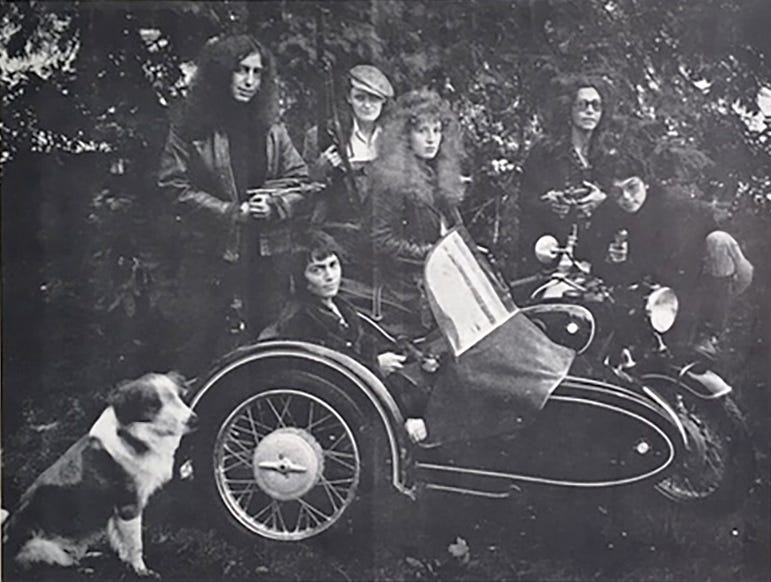
AUTHOR'S NOTE: This is an edited version of the first chapter of a novel of mine published in 1997. People who read the novels in my Blacklock Trilogy, The Revolution of Little Girls, Terminal Velocity, and Tomb of the Unknown Racist, often assume that I am actually the narrator of these works. Nope, these are novels, they are fiction, and the narrator is named Ellen Burns. My life and personality do overlap with Ellen’s, but she’s her own person. Maybe Ellen Burns is who I wish I’d been.
TERMINAL VELOCITY: CHAPTER 1
In 1970 I realized that the Sixties were passing me by. I had never even smoked a joint, or slept with anyone besides my husband. A year later I had left Nicky, changed my name from Ellen to Rain, and moved to a radical lesbian commune in California named Red Moon Rising, where I was playing the Ten of Hearts in an outdoor production of Alice in Wonderland when two FBI agents arrived to arrest the Red Queen.
The Red Queen was my lover, and her name, I thought, was Jordan Wallace. It turned out that she was Nancy Jordan, and a flyer about her was hanging in post offices all over the country. In the flyer, her hair was blond.
At Red Moon Rising, in addition to the old homestead that served as the main house, there were two long pastures studded with dark green oaks, and 190 acres of woods with three tepees hidden within them. Our musical feminist version of Alice in Wonderland was taking place mainly in the west pasture. As the Ten of Hearts, my job was to shepherd the audience from the set of the Mad Hatter's tea party through a small ditch into the adjoining field, where the final scene, the croquet match, would occur. I was also supposed to participate in the croquet game, linking hands with another hearts card to form a wicket; Jordan, as the Red Queen, would then use her flamingo mallet to hit Amethyst Woman, playing one of the balls, through the wicket.
I didn't much like Amethyst Woman, who'd been rolling around the yard all week, practicing. She was a Marxist dentist transformed into a radical lesbian only a year before me, yet she branded me a feminist novice because of my more recent name change (she'd been Amethyst Woman legally for over a year) and my ex-husband, who was still trailing me around. Amethyst claimed that I was sexually barbaric, not genuinely political, and during the early rehearsals for Alice she had even called a house meeting to discuss the "overly animalistic sounds"of my relationship with Jordan. We were exclusive and disruptive, Amethyst claimed, and whatever we did sounded too much like sex with men. "You're listening to us?" I said, but Jordan shushed me with a wave of her hand. "Which men could you possibly be talking about, Amethyst? I must've missed something when I was straight." Jordan then mentioned the fact that she'd been Amethyst’s lover “for about ten seconds" when the group was still trying to smash monogamy, a period in their history she insisted I was fortunate to have missed, and that Amethyst was merely jealous. Jealousy, of course, was politically incorrect. Jordan concluded with her thoughts about the radical nature of the female orgasm. "The male orgasm,"she said, "has a biological purpose because it is directly connected to procreation. The female orgasm is by its very nature revolutionary. It is connected to nothing!"
Jordan was as overbearing as she was charismatic, and the combination was persuasive. She not only held sway over me, everyone else in the group seemed similarly compelled. She and Artemis Foote were our natural leaders, although we professed not to believe in authority. At the meeting, Artemis Foote offered the opinion that Jordan and I were "appropriate in our exploration of the sexual frontiers," and Amethyst Woman sullenly retreated.
When the two FBI agents stepped out of the crowd, I was standing on the path between the Mad Hatter's tea party and the croquet field. They didn't look like my notion of FBI agents, they looked more like hippies. Both had scraggly hair held back by sweaty headbands. The one in cutoffs displayed very hairy legs, and the other sported a pair of purple overalls I'd been coveting.
I'd taken a mild dose of psilocybin a couple of hours before the performance, so colors were brighter and light tended to split into brilliant geometric patterns. The members of Red Moon Rising had agreed to forego drugs during what we were calling Alice Does Wonderland, but I didn't have a significant part, mostly crowd-herding, no spoken lines at all, so I had decided that it was okay to sprinkle part of a capsule of psilocybin onto my potato salad during lunch. Just before Pearl had called everyone into the kitchen to eat, I'd sneaked our drug box into the bathroom and gazed into it longingly. Marijuana would make me tired, and people might smell it. Acid was too risky emotionally. We only had one hit of mescaline left, which would be missed. Though psilocybin was still plentiful, it too posed a problem.
Pearl, who claimed to be a witch, worked part-time at the health food store in town, earning only minimum wage. She decided to buy an ounce of psilocybin spores, enough to make six hundred capsules, which she could then sell for two dollars each. The ounce of spores only costs three hundred dollars. Pearl insisted that dealing was not capitalism. Unfortunately, none of us at Red Moon Rising or any of our friends, including the source who arranged the buy, knew how to handle the spores or what they might look like. Pearl had been instructed to cut them with bulk Vitamin C powder and then put them into emptied gelatin capsules.
When the spores arrived through the mail, sealed in a tiny transparent envelope, Pearl said, “That’s less than a tablespoon. How in Hera are we going to cut this into six hundred hits?” Pearl was always saying “how in Hera” and “by Hera,” expressions she had adopted from Wonder Woman comics.
The tedious process we devised took many patient hours with a razor blade, a knife, and a tiny spoon. When we were almost through, Pearl ran two fingers inside the empty glassine envelope and licked them. This, it turned out, was a mistake, and Pearl had to be babysat for thirty-six hours. She couldn’t get out of her chair by herself or pull down her jeans to pee without being helped. Whenever we asked how she was, she said, very slowly, “It….”
Amethyst and I had finished capping the psilocybin together, and perhaps because we didn’t like each other, the capsules were of uneven strength. One might do nothing for you, but the next might shoot you over a rainbow. Twice, I’d taken capsules with no effect beyond a mild speed-like buzz, but once Jordan found me facedown in the vegetable garden rocking my pelvis. I was supposed to be weeding, but instead I was having a remarkable sexual experience with the earth.
Half a capsule on my potato salad had seemed judicious, circumspect, even adult. I was surprised, therefore, that diamond patterning began to appear on the FBI agent’s purple overalls.
“I’ve been admiring your britches,” I said when the two agents separated from the crowd surrounding the Mad Hatter’s tea party and joined me on the path.
The taller one had dark brown eyes I couldn’t see into at all, but Purple Overalls had light, friendly eyes, and I was drawn to him instantly. Without my dark glasses protecting me, his soul might have swum right into mine. Perhaps Amethyst Woman was right and I was a spoiled, white, ruling-class child who would not accept discipline; I had been told not to wear the dark glasses, which did look strange with my costume.
Large facsimiles of the ten of hearts hung like sandwich boards down my front and back; underneath, I wore a white turtleneck and tights. On my head was a cardboard crown held on by a string of elastic. My face was coated with white makeup, onto which round red cheeks had been rouged. Despite my insistence on the shades and the secret dose of psilocybin, I thought I was being quite cooperative and was overcoming my privileged background nicely.
Amethyst Woman claimed to be part Native American. She liked calling me white, and she hated my Southern accent. I thought she was obnoxious, but since she was a Marxist dentist, we did have a large nitrous oxide tank for parties. “The people need dental care too, Amethyst would say as she left for her office.
Embroidered on the back of her white doctor's coat was a women's symbol with a fist in its center; two of her workdays were for "wimmin only," three for "the people."Amethyst had stopped saying “the masses” because Ross, her ex-lover, was a respected left-wing journalist, and Ross made vicious fun of Amethyst's jargon. “Amalgamated fillings for all the people," Ross liked to mutter.
Ross, who was writing a column for Ramparts Magazine, wore army jackets and granny glasses. Her hair was long and stringy, and her round eyes always looked surprised. “I'm never," she once said to me, “I'm never writing for The New York Review of Books again!"
She and Amethyst, whose original name, Judy Shapiro, didn't sound Native American to me, were both around thirty-five years old, some ten years older, I assumed, than the rest of us. They had long political histories. “Oh, the Trots," they would say, when I had no idea who the Trots were. The betrayal they felt about men like Abbie Hoffman and Jerry Rubin was personal in a way that seemed puzzling, since Southerners usually reserve this kind of anger for their families. "Abbie has turned out to be such an asshole," Amethyst would say, and, “Jerry, Jerry, Jerry, what a disappointment." Ross even knew Jane Fonda. “Jane's really nice. She’s naive, but nice." Once Ross said to me, "Haven't you read Alexander Berkman's prison memoirs? Why, you probably don't even know who Emma Goldman is."
"Of course, I know who Emma Goldman is, Ross. I edited Beautiful Rebellion, remember?" Actually, I only knew about Emma Goldman because my college roommate, a political science major, named her golden retriever that.
All of us had been somebody else before we came to Red Moon Rising, except for Artemis Foote, whose life had been so unusual it did not require transformation. Artemis owned the Red Moon Rising property, and she was the only child of famous art collectors. They had named her Artemis because they wanted to be able to call their child Art, no matter what sex it turned out to be. Artemis' mother, Jane Preston Foote, was supposedly a psychoanalyst; her father, Howard Foote, had been one of the Texas Footes and the major inheritor of the Foote family fortune. To house the Foote collection, a new wing of the Houston Museum of Fine Arts was currently under construction.
Artemis was a talented artist, but she had trouble taking herself seriously. "Just imagine," she told me, "growing up with Rouault and Matisse and Rodin all around the house. I had a Degas hanging in my bedroom. This was not an atmosphere in which one could learn to play."
She treated being a radical as a kind of game, just as she treated being rich. She was smart and fun and interesting-looking, and I liked her a lot.
The first time I saw Artemis Foote, I’d been genuinely startled. She had come to my office to discuss The Raisin Book. At the time, I was a junior editor at a small publishing house in Boston. Although only a few years out of college, I had already developed a minor reputation for commercially successful cookbooks (The Gourmet Woodstove was mine) and for books sympathetic to various movements (Black Black Black as well as The Terminal Brassiere), so I had not been an unlikely choice for Artemis Foote's goofy proposal.
I was in my office, standing by the bookshelf instead of at my desk with my nameplate on it, when her striking head appeared in the open doorway. "I'm looking for Ellen Sommers."
"What do you want with her?" I was unable to keep a trace of alarm out of my voice.
Artemis Foote's blue eyes had an unusual clarity, and her long black hair, pulled back and braided, made the angles of her face as severe as a dancer's. But it was something else that made her so unnerving — an aura of authenticity, perhaps, combined with the scent of all that money.
"I have an appointment with her."
"I'm Ellen, I guess."
"You guess?" She stepped easily into my office. She wore jeans with the knees torn out, a low-cut Indian blouse, a buckskin jacket with fringe, and snakeskin cowboy boots.
Regaining my composure, I said, "I guess I'm just one of those wunderkinds. Just one of those people who can't get any authority in what they say. Oh well, I guess."
She gave me a glance of appreciation, then pointed at a picture of Nicky on my desk. "The boyfriend?”
"The husband." I smiled as if I weren't annoyed.
"Is Sommers your real name?"
"No, it's my husband's name. My father's name was Burns. Did you manage to get one that's original with you?"
"Truce." She sat down in my visitor's chair and looked up at me. Her irises were dark blue at the edges, paler toward the center."I guess I'm Artemis Foote."
I felt surprisingly self-conscious. Having been a minor beauty queen in high school, I knew I was reasonably good-looking, so I thought maybe it was my clothes that were unsettling me. I was wearing what I considered unobtrusively professional garments: an A-line wool skirt, a Gant shirt, brown loafers with hose instead of socks. But watching Artemis Foote assess me, I suddenly knew them for what they were: clothes appropriate to a Duke sorority girl who had lost herself in the cold, wicked North.
"I’m glad you could come,” I said, trying to regain some authority. “I think The Raisin Book has possibilities."
Artemis Foote had proposed a series of titled drawings of raisins, and she had sent along several examples. “Raisin the Dead" depicted a raisin-like figure in a white robe standing beside a coffin in which another raisin was attempting to sit up. “Hell Raisin" showed a white-robed raisin walking through flames. "The Age of Raisin” pictured a raisin named Plato declaiming to a group in front of a cave. My favorite, though, was “Consciousness Raisin," which pictured a group of angry-looking raisins sitting around a copy of Sisterhood Is Powerful.
These drawings were compelling and technically assured; the raisins all looked very personal about their situations. The note from Artemis Foote - where, I wondered, had I heard that name? - predicted "a large counterculture audience." Yet her proposal had the flavor of an elaborate joke. I'd had my assistant call and set up this appointment.
Both my husband and my mother blame the extreme changes in my life on my relationship with Artemis Foote.
I love listening to you reading this
I'd forgotten how much I loved this. So readable, so compelling. I wanted more! Guess I'll have to dig up my copy.