
ROCKY FOR A DAY
....the "new" journalism in 1978.....

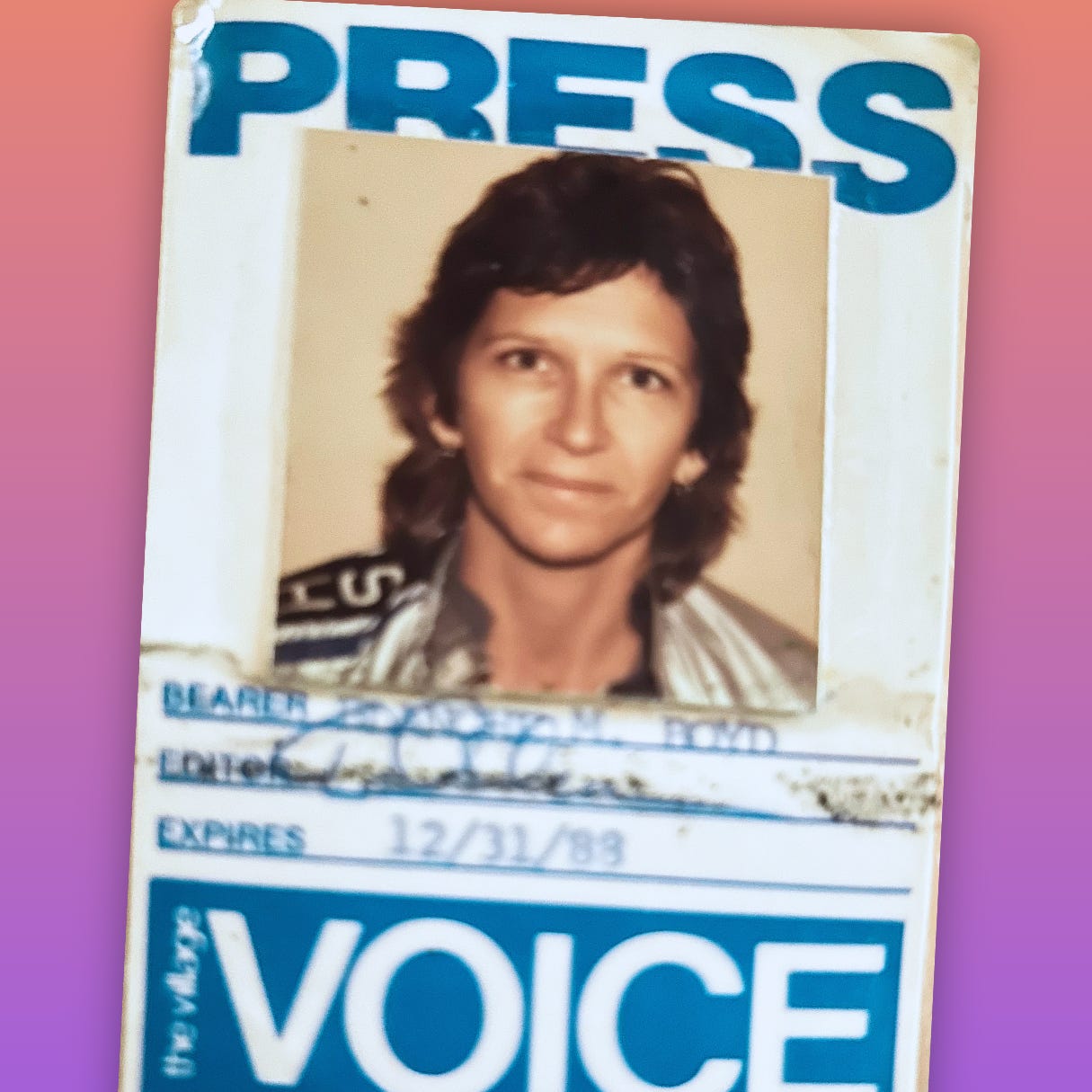
Blood landed on my lips the first night. The Tough Man Contests had come to Charleston, and these were only the preliminaries. Martha, Mindy, and I were sitting at ringside, right beside the judges. I trusted the ropes after the first few bouts, and when the huge, wet bodies of the fighters fell above me, I didn’t bother to turn my head. Martha wiped the blood and sweat off my face. “Jesus,” she said, “what’s going to happen in the finals?”
In college I had studied fiction writing (another dangerous business), and one of my teachers had warned me about linear tension: “If the girl is raped with a pistol at the beginning of your story, it will be hard for the reader to care much when her dead body is gangbanged in chapter five.” I took this advice seriously, but the Tough Man Contest was not fiction.
The Tough Man pageants were more like beauty contests for men. Any male who weighed over 175 pounds got a chance to play Rocky for a day. The only restrictions were that entrants pass a medical exam, sign an injury release form, and hadn’t won a sanctioned amateur boxing match within five years.
Dean Oswald was one of the Tough Man organizers. A sleekly muscled ex-boxer with a gray pointed beard, Oswald told me, “People want to see fights. They want to see crashes. They don’t go to car races to see winners, they go to see wrecks. They like to see these big guys punch.” He added confidentially, “The American people are very violent.” Oswald’s voice was rich and persuasive, so he doubled as emcee. When I asked how to spell his name he said, “Oswald as in Oswald.”
At least fifty Tough Man competitions had been held within the last year. It didn’t cost anything to enter, but it cost some $10 a ticket to watch. Runners-up would win $500, and the winners would get $1,000.
“I’d fight for that kind of money,” Mindy said. Mindy is a television videographer in the daytime. At night she’s a dance teacher. Mindy, who has the slight build and rapid gestures of the born speedy, went to the ToughMan Contest with Martha and me “just for fun.” Martha, a photographer and graphic artist, had made a superb copy of her own press pass for Mindy. Martha was nervous, so she brought a quart of bourbon in her camera bag. I was nervous, so I brought a few joints. The audience was nearly half women, but we were the only female press.
The first night was a blur of fighting and screaming. The music from the movie ROCKY played before each bout. Between rounds a pretty girl in a blue bikini walked around the ring holding up a poster that said one, two, or three, depending on the round. Miller beer, the local sponsor, was paying for her services.
The thirty-two contestants wore gloves and mouthpieces, just like real boxers. But over their shorts they wore heavy black leather jock straps, like codpieces, which starkly connected the violence with sex. Each fight was three two-minute rounds.
Wayne Altman, a six-foot-five-inch white man with long hair and a headband reminiscent of flower children, fought a black man named Woodrow Wilson. Wilson, overweight and goateed, was a foot shorter than Altman. He didn’t have much of a chance, but he kept touching himself on the chest in a go-on-hit-me gesture, even when he seemed barely conscious.
A potbellied disc jockey named Buzz came into the ring wearing an orange cape, prancing like Ali. He picked up the Miller beer girl and swung her around in the air. His opponent was a young black man who quickly bloodied Buzz’s nose. Buzz took an eight count, still standing, before the ref stopped the fight.
“Why didn’t you lay down, Buzz?” Oswald asked through the mike, and Buzz flopped dramatically onto the canvas. The winner, William Peeler, was trying to look cool, but he was hurt too, and he nearly fell out of the ring.
Two black guys did what looked more like street-fighting than boxing. When one of them got thrown to his knees and covered his head with his gloves, the audience laughed and booed. The other guy jumped flat on top of him. Oswald said whoever was booing should sign up and fight.
Some white men behind me had begun to cheer against blacks. All of the organizers I met were white, but the audience and contestants were mixed. The drawings for opponents were supposed to be random. However, most of the pairings were black-white.
Mindy kept pouring bourbon. Martha kept taking pictures. I bought some M and M’s but they were hot and crushed. A black fighter got knocked out and had to be carried away. A black man in the audience went berserk. A dozen cops converged on him like a pack and dragged him out.
Martha whispered to me, “Do you think this event eases racial tension or makes it worse?” She looked worried, even scared. “Tell me again why we are watching this?”
I was rubbing my thighs while a fist snapped a fighter’s head back. “It’s a male fantasy and I want to write about it.”
A miserable-looking boy, maybe twelve years old, came over to talk to the judge sitting beside me. “I’m in trouble with Momma, Dad. I been yelling stuff at the Miller girl.”
“What kind of stuff?”
“You know. Stuff.”
“You ain’t in trouble,” the judge said. “Go on back to your seat.” He turned to me and said cheerfully, “He’s been yelling stuff at the Miller girl.” He rose and went to talk to Miss Miller, who had put a T-shirt on over her bikini. The next time she walked past the kid, she leaned over the ropes and winked heavily at him. Two bright red circles appeared like wax on his cheeks. He squirmed in his chair and hung his head.
“Ha, ha, ha,” the judge said. “He’ll remember that one for a while.”
“Will the man from the Charleston Police Department, Clay Thornhill, come to ringside!” Oswald shouted into the mike.
The theme from ROCKY was nearly drowned out by cheers and boos. “This really is a psychodrama,” Martha said. Thornhill was white, and, luckily, so was his opponent. Thornhill hurt him fast, and at the end of the first round he sat dazed in his corner. Miss Miller walked past him and raised her T-shirt. He came out for round two fighting like a crazy man, and Thornhill quickly knocked him down. At the ten count he hadn’t even twitched. Intermission was announced while two doctors were giving him smelling salts and pulling down his codpiece so his crotch could breathe.
Martha and I went outside with the Miller beer girl to smoke joints and drink bourbon. “I’m an unemployed stripper,” Miss Miller told us. Her real name was Kim, and she used to work in Goose Creek for a woman named Mercy. Kim was sweetly pretty, but her eyes seemed glazed.”I may be arrested for assault. I blacked my boyfriend’s eye.”
“Before you saw this?” Martha said, pulling out the quart. We began to pass it with the joint. “I’m pretty fucked up,” I said, then, “Hi,” I said to the badge in front of my face.
The plainclothes policeman was furious. “How could you be so stupid? You’re fifty feet from the entrance, for God’s sake! You’re standing beside my car, for God’s sake! Pour it out! Put it out!”
Martha emptied what was left of the bourbon onto the pavement and Miss Miller stomped on the joint. I showed him my Village Voice press badge. “I’m working too.”
We went to look for Mindy. While we were standing among the crowd in front of the main doors, we watched a man walk up behind a friend of his. He laid his hand on the friend’s shoulder. “How’re you doing?” The friend turned and socked him in the face.
The rest of the fighting that night was unremarkable. Violence may be orgasmic but it peaks hard and fast, becomes jerky, abrupt, and disappointing. When the blood landed on my face, I didn’t even care. I felt the beginnings of revulsion. I had the kind of headache that comes from being hit.
The next morning I tore the door handle off my car. “Must have been loose,” I mumbled to my dog. Then I broke an overhead light fixture, trying to kill a fly with a swatter. “I don’t believe in this stuff,” I told my dog, and drove into town early.
County Hall, where the Tough Man competition was being held, is a cavernous building in an unfashionable area of Charleston. Boxers, wrestlers, and rock stars perform here. An opera singer certainly wouldn’t. I parked in the deserted yard. Fiction may be linear, but memory is not. There was something I hadn’t wanted to think about last night.
Next door to County Hall is William Enston Homes for the Aged. My grandmother lived in one of these ugly Victorian buildings. She lived in the one right next to County Hall. She died there too, when I was eleven years old. My father was with her. He told me stuff he shouldn’t, how once she’d struggled for air, running across the room, and he had to hold her down trying to quiet her. He said her fingernails had turned blue. A year later my father was killed in a wreck.
After my father’s death I wouldn’t sleep in the nightgown my grandmother had given me. I wanted to burn it, but I knew that was too violent. At William Enston Homes, my grandmother had a television to occupy her silence. Her favorite show was “Queen for a Day.” Every afternoon she watched while women told ghastly stories about their lives. Then the audience applauded to choose the worst story.
After I’d sat in the parking lot awhile, I drove to Martha’s for dinner. Mindy had already arrived. Martha’s apartment was in a hundred-year-old house in the elegant area called South of Broad. Several years before Martha had been born in Alabama, her mother lost her right arm. She had been riding in a car with her arm on the open window, and a board protruding from a passing truck caught her elbow. Her arm tore off. Martha’s childhood had been haunted by a clumsy prosthetic device hanging in a closet, and Martha’s apartment contained two mannequins. The first, named Melissa, stood by the front door wearing a tuxedo vest and an antique top hat but had no trousers and no arms. Angela was simply a white wicker torso in the corner. A painted plaster head of a woman rested on the mantel, and a deformed doll named Courtney sat in a tiny chair. Martha’s stereo speakers rested on Red Cross shipping boxes labeled “Human Blood.”
“Violence is the opposite of art,” Martha said.
We were eating rare steak. She had laid a tablecloth, lit candles, and put joints in a silver cigarette case. “And a fine dinner is the first defense.” She had also sautéed fresh spinach “for brute strength, just in case.”
I said, “Why do you suppose those guys want to fight?”
“Haven’t you ever been hit in the face?” Mindy asked. “It’s a real high.” Mindy’s hair was curly and it stuck straight up, as if she had been shocked.
Martha had pale straight hair and pale eyes behind rimless glasses. “Any way you pass out is a trip,” Martha said. “When I was little, I used to hyperventilate until I lost consciousness. It was a neighborhood game.”
“Were you hit in the face when you were a kid too?” I asked. “I wasn’t.”
“My parents were both librarians,” Martha said. “I got locked in the bathroom when I was five years old for saying a double negative.”
Paranoia. Maybe it was from the cheap pint of bourbon we took with us, in case we’d have to pour it out again. Maybe it was from thinking about my grandmother. Maybe it was the fear we might really get busted. Would the same cop be there? See us?
Paranoia is the dark sliding and moving. Paranoia is light hurting the brain. “You drive,” I said to Mindy. “I’m busy hanging on.”
We arrived at County Hall before the fights started. The crowd was about the same size. Maybe a thousand, maybe twelve hundred. Roughly half black, half white. More than a third women.
The psychologist Carl Jung speculated that human consciousness first began as a response to violence. Maybe someone killed a beloved brother or son, and when the rage was over, the loved one was still dead. “Human consciousness,” according to Jung, “is a recent acquisition of nature….It is frail, and easily injured.”
My vision seemed flat, as if my depth perception was disappearing. Although the crowd was quieter, it appeared to bulge in places. “Have you read Jung?” I asked Mindy. We had taken our seats right under the ropes. Martha was wandering with her camera.
“Nope. Never will, either.” She grinned at me.
I thought of history accelerating, one long act contracting toward a single point. Sixteen fights the first night. Now eight more. Then four. Then two. Then one. Apocalyptic release. Orgasm. Death. Winners. Martha once said to me,“ The hardest things to understand are right in front of us. Like sex. Like sleep.”
I must have looked weird because Mindy put her hand on my arm and said, “Want to hear a bad joke? You look rocky.”
Oswald began to boom through the mike, repeating the rules, hyping the crowd. Then he told everyone to stand up for the National Anthem. We stood, but there was no music. “The tape is broken,” Oswald said. “I can’t sing, so let’s get on with the fights. We’ll bring on the anthem later.”
The theme from Rocky played while the sixteen remaining fighters ran single file around the hall, like horses on display. I saw one fighter go find his girlfriend in the crowd. He touched her as if he were knocking on wood.
Martha came back to her seat. “It’s not psychodrama,” I said. “It’s group psychosis.”
Martha shrugged happily. “Pain is pleasure, or everybody wouldn’t be having such a good time.”
A cornerman was struggling to pull the heavy jock strap over the shorts of an overweight man. “It won’t hurt nothing? You sure?”
“You gotta wear one, you gotta wear one.”
His opponent was a bald white guy, at forty-eight the oldest man fighting.
The bell rang. The old guy, Giordano, scored fast with a left. The referee laughed with delight. “Hit him, Pop,” someone yelled.
Boxing, it can be argued, is an art. It is at least a sport. Giordano brought dignity into the ring, but the Tough Man Contest was not sport. It was theatre. “Everybody would like to beat the hell out of somebody,” one of the organizers had said to me. Gloves may protect the hands but they also blunt blows. Leather protects the crotch. The idea of violence without consequences is thrilling. In California, in the sixties, when humanistic psychology was in vogue, I knew several people who owned boffers. Boffers were sponge-rubber swords you could clobber people with without damaging them.
I realized Martha was the person yelling, “Hit him, Pop!”
Mindy leaned across her and handed me a Coke with bourbon. She stage-whispered, “Reminds me of an acting class I took. All the boys wanted to play Jesus.”
“This is great tonight!”Martha clubbed me on the shoulder. “I’m not a bit scared!”
“Maybe violence is a path of knowledge,” I whispered to Mindy. Martha was getting tired of us talking across her, so she separated us as if she were a referee. “Back off, ladies.”
In the second round Giordano was tiring. His opponent crouched and waved his gloves, but he was no match for the older man. Giordano looked grim, stony. The crowd loved Giordano, who at the final bell smiled like a delighted kid and hugged the black man as intensely as a lover.
Two blonde teenage girls were standing near Giordano’s corner while his victory was announced. One of them was crying. They were both wearing green T-shirts that said MY PAPA, THE CHAMP.
In the next fight Wayne Altman went up against a man with coppery skin and a heroic body. Both men seemed to know what they were doing in a ring, but Altman had about five inches on his opponent and maybe twenty-five pounds. Altman’snose began to bleed in the first round. By the second it seemed to have swollen shut. To breathe, he had to suck hard around his mouthpiece. His mouth expanded and contracted in an awful rhythm while blood ran from his mustache.
“That white guy’s demo’d,” Martha said when the fight was over. She pointed at the tube that ran from the basin the fighters spit into. The bottom curve of the plastic tube was dark with blood. “And they use the same mouthpiece over and over,” Martha said. “I’ve been watching.”
“It’s gotta be white!” I heard someone yell. “It better be white!”
The cornerman dropped bloody adhesive tape onto my notebook and smiled down at me. I threw it at Mindy. “Souvenir!”
“Great! I’ll put it with my collection of used condoms!”
Altman won on a split decision. “The white guys are ahead!” the voice behind me shouted.
During intermission, I insisted we walk to the car to smoke a joint. We’d parked far down the street, in front of a supermarket. My paranoia had eased, but I was still jumpy. We turned on the radio and air conditioner while I tried to relax. “I feel like I’m getting half the facts wrong,” I said.
“Accuracy is overrated,” Mindy said.
Martha held up the bourbon. “Here’s to telling the story, not the way it happened, but the way it should be remembered.”
“Hey, that’s pretty smart,” Mindy said.
I wanted to tell them about my grandmother. I wanted to tell them how, earlier that day, the past had torn the present like a piece of paper. Instead I said I was nauseated, which was true.
Too much time had gone by, and I was afraid we’d miss Giordano in his next fight, so I insisted we trot back to County Hall, instead of walking. When we reached the paved parking lot we could hear wild cheering, and we broke into a run. I was ahead of Martha and Mindy, so I only saw what happened out of the corner of my eye. Martha stumbled, tripped, and skidded on the pavement. I heard the pint break.
I thought she’d hop right back up but she didn’t. She was curled on her side like a caterpillar.
“Good thing I’ve got the camera,” Mindy said, extending her hand.
“Let me stay here a minute,” Martha said.
I didn’t like the look on her face, so I picked up the camera bag she’d been carrying and gingerly turned it inside out. The film canisters were wet but sealed. I shook the dripping pieces of glass onto the ground. “We sure do lose a lot of whiskey.”
Martha sat up. One elbow was scraped, the knee of her jeans was torn, and her palms were bleeding.
“Audience participation,’ Mindy said.
“Martha’s got stigmata,’ I said.
“I don’t think this is so funny,” Martha said.
While Martha went to the bathroom to wash off the blood and grime, Mindy and I went back to our seats. When Martha came back, her eyes had a hard, inward look. I told her Giordano didn’t want to fight again, and that the cheering we’d heard had been for a knockout.
She didn’t answer. ”Are you really okay?” Again she didn’t answer.
One of the organizers, a wiry, skinny man, tapped me on the shoulder. “Would you girls be willing to lead the crowd in the National Anthem? None of us can sing.”
Martha turned her camera toward him like a weapon.
“I guess we can’t sing either,” I said. “Even if we are girls.”
The rounds after intermission were disappointing. A lot of people had been injured or had withdrawn. Only two things happened that I thought were significant. The first was that, during the next to the last match, Martha screamed, “Kill Picasso!” The second was that, while everybody who’d won at least one fight came into the ring to receive a tinny little trophy, Mindy went to the microphone and led the crowd, a cappella, in “The Star-Spangled Banner.” She shook her ass and jabbed her finger at the sky like a rock star.
Later, in the parking lot, I gagged, then gagged again.
“Gonna throw up?” Mindy asked cheerfully.
I shook my head. “Did you know my grandmother died in that building? That one right there?”
Martha put her arm around me. “Don’t worry,” she said. “It’s only the present, and it’s almost over.”
“I know,” I said. “I’m just knocked out.”