
HONORING DOROTHY ALLISON
......Dorothy, I've a feeling we're not in South Carolina anymore.....

I met Dorothy Allison in the summer of 1974 at Sagaris, an independent Feminist Studies Institute held in Vermont at Johnson State College. Dorothy was a student, and I was part of the Sagaris Collective, founders of this event.
I’d been Visiting Director of Feminist Studies at Goddard College that spring, where I got tired of male faculty telling me what I could and could not do with the tiny budget Feminist Studies had been allowed, so I banded with Joan Peters, an assistant professor at Middlebury, a small group of Goddard students, and a feminist lawyer from Montpelier, and we took that $200 budget and incorporated as Sagaris, a nonprofit educational organization.
Of course, nobody knew what Feminist Studies actually was. I certainly didn’t. I’d been hired at Goddard because (I think) my first novel had just come out from Daughters Inc., a new feminist press, and I held a Master’s Degree from Stanford, which made me mildly respectable academically. (I had almost rejected that degree because my first novel, which was my ‘thesis’, had to be typed professionally; $300 was a lot of money to me, I could type just fine, and I was furious.) Also, I had begun beating the drum of my newly discovered radical lesbian feminism to anyone who would listen.
Even though the Sagaris collective had no clear notion yet of what Feminist Studies was, we wrote to every famous radical feminist we’d ever heard of and invited them to teach. We proposed two two-week sessions and said pay would be minimal, but we would provide an exciting, self-invented space for evolving feminist thought. This was quite a bluff, and it worked. Students enrolled from 41 states and Canada. We received the Ms Foundation’s first grant, and we even wrangled money out of Carnegie. Also, I’d had a chance to meet Marietta Sackler in NY - yes, those Sackler’s – and I hit her up for $400; she gave me $500 and said I was charming.
One of the things I liked to say (and still believe) is that authority belongs to those who seize it, and the Sagaris Collective seized our authority. Someone with more perspective should write about Sagaris because it was an important event, but I’m mostly describing it here to give a sense of what radical feminism could mean in 1974, and because someone who turned out to be as literarily significant as Dorothy Allison drove all the way up from Florida to attend.
Dorothy was a 22 year old college student who showed up with a couple of friends. She worked mainly with Bertha Harris, a wonderful fiction writer, (I may write about Harris in a later post), but the smoldering Dorothy was already noticeable.
And that’s what I remember about Dorothy Allison from Sagaris, because the Collective was under great pressure, we were an intellectual and organizational mess, and men in dark suits and dark glasses were showing up and photographing us. We had invited a controversial former fugitive named Pat Swinton to speak and all participants began arguing bitterly, and meanwhile we made the New York Times and the Associated Press.
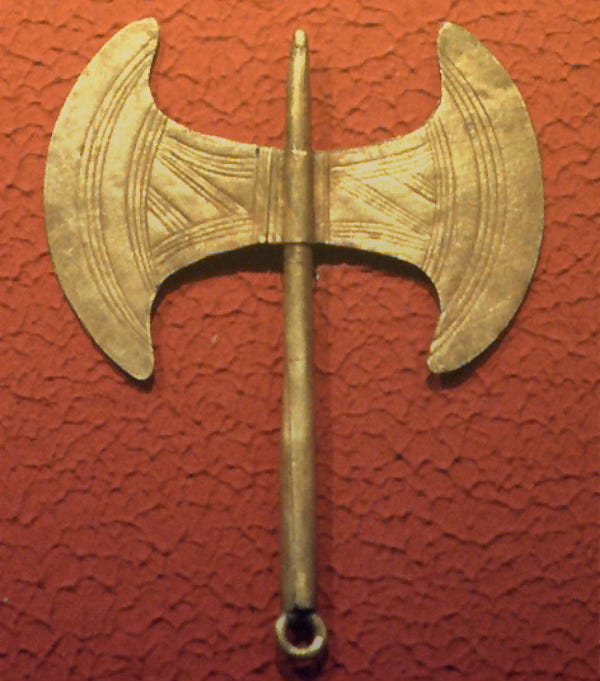
Sagaris is another name for labrys, the double-edged axe of the Amazons, and what a metaphor that turned out to be. The members of the collective all wore silver sagarises on chains around our necks, and one afternoon when we took a break to swim in a quarry, one of our group jumped off a cliff into the water and caught her finger on her sagaris in mid-air, exposing a streak of bloody pink meat on her ring finger that required stitches.
Although I don’t remember more about Dorothy, I learned that she certainly remembered me when the pieces I wrote later in the Village Voice about South Carolina, where Dorothy and I both originated, got released in 1982 as a collection called The Redneck Way of Knowledge. I was invited to speak at a gay literary conference in California, and I met there with Dorothy, who told me she had four copies, her own small lending library, and that she thought Redneck was ‘a classic.’ I thought she was kidding, but I quickly learned that Dorothy did not joke about literature. She had not yet published Bastard Out of Carolina, but she projected an amazing authority.
What I am trying to say is this: Dorothy championed me as a writer. She protected me. She promoted me. I was newly sober and felt wild-eyed with fright and confusion, though I probably didn’t seem that way. Masha Gessen told me I had been very kind to her at that conference and I thought, me? I was kind to the brilliant Masha Gessen, who I think of as a contemporary Hannah Arendt?
Why this matters is that Dorothy helped so many writers, believed in us, nurtured us, and fought for us. When I finally wrote what I thought was a good novel, The Revolution of Little Girls, it won the Lambda Award for Lesbian Fiction, and I’m certain Dorothy was the force behind that choice. And when Redneck was re-released by Vintage in the mid 90s, Dorothy wrote a stunning Introduction about our personal histories and how much she admired this book.
Would you understand if I say that part of why I know I matter as a writer is because Dorothy Allison told me so? Would you understand that part of the way I know I am a good person is because someone like Masha Gessen said I was good to her, even when I was frightened and fragile and felt out of my depth?
I taught creative writing for many years at Connecticut College and at the Bennington Writing Workshops, and an extraordinary list of students came out of my classes; David Grann at the New Yorker; Jazmine Hughes, from the New York Times Sunday Magazine; Lee Eisenberg, who produced The Office, Soraya Palmer, who just won a big prize for her first novel; Hannah Tinti, the novelist who founded One Story magazine; Ann Napolitano, whose novel Hello Beautiful was Oprah’s 25th Anniversary Book Club choice? And Jessica Soffer, Soon Wiley, Martha Witt, Caroline Lazar? If I’ve left you out, it doesn’t mean I’ve forgotten you, but it’s late at night, and I’m old now.
What I’ve given to other writers is what Dorothy Allison gave me: a deep seriousness about the value of literature, and a belief in the power of my own voice.
I’ve been seeing a lot of tributes to Dorothy on Facebook, and I’m hoping other writers will tell the stories of what Dorothy Allison did for them. I’m sure there are many besides mine.
.
Who are you? Remind me. You came up from Charleston, that hotbed of radical feminism? Tell me who you’ve become now.
Your opinion means a lot.